
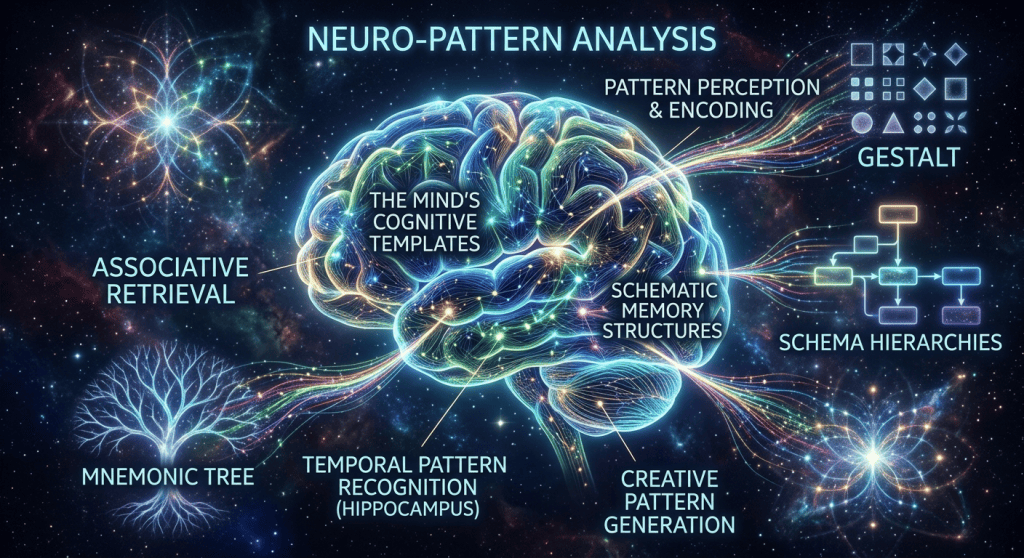
There is something that has played a very important role in my life that I have only recently found better language for: pattern recognition. More specifically, I have been thinking about the relationship between pattern recognition and discernment, and how much of my ability to navigate difficult situations has depended on both. I don’t think they are the same thing, but I do believe they work together in ways that have helped me understand people, situations, and systems that I might not have otherwise understood.
Pattern recognition is essentially the ability to recognize similarities, repetitions, connections, or inconsistencies across different experiences. Sometimes we recognize a pattern almost immediately. Other times, it takes months or even years before enough pieces come together for us to realize that something we are experiencing now resembles something we have experienced before. The individual events may look different on the surface, but there can be something underneath them that feels familiar.
For me, pattern recognition has always been very visual. I don’t necessarily process everything in words first. Sometimes I see things in pictures. Something will happen, and I may not immediately be able to explain why it bothered me or what exactly I noticed, but something gets stored in my mind. Then, when something similar happens later, that earlier experience comes back to me almost like a picture. It is as though my brain pulls out a puzzle piece and says, “This belongs with that.” I may not have the words yet, but I recognize the connection.
I am a very observant person. I notice tone of voice, intonation, changes in the way someone speaks to me, facial expressions, body language, pauses, and small movements. Sometimes I notice things that I don’t even have words for initially. I may simply have a sense that something has changed. It isn’t necessarily that I can immediately explain what the change means. I just know that I noticed something, and my brain holds onto it.
I think there is a reason some people become particularly sensitive to these things. When you spend a lot of time in a dysfunctional or unpredictable environment, you can become extremely aware of what is happening around you. You learn to pay attention to changes in mood, tone, behavior, and what people say and do. You may become sensitive to the smallest shifts because those shifts can tell you something about what is happening beneath the surface.
There is a downside to that kind of heightened awareness. Sometimes it can become hypervigilance, and constantly monitoring an environment for changes can be exhausting. I don’t want to romanticize that. There is nothing inherently healthy about feeling as though you always have to be on alert. At the same time, I can’t deny that being highly observant has also become an important part of how I understand the world.
For me, those observations eventually began connecting with one another. Someone might tell me something, and later tell me something different. Maybe the difference seems insignificant at first, so I don’t say anything. But I remember it. Then something similar happens again. Another piece of information doesn’t line up with something I was told previously, and eventually my brain starts putting those pieces together. I might think, “Wait a minute. You didn’t say that before.”
That is where pattern recognition comes in for me. My brain is essentially taking notes, even when I am not consciously taking notes. Sometimes I actually do journal because I want to make sure I am remembering something correctly. I might go back and read something I wrote months earlier and realize that I wasn’t imagining what I remembered. I actually wrote it down when it happened. Other times I don’t journal at all. The information simply stays with me, and as more experiences occur, they begin connecting with what I already know.
Eventually, enough pieces come together that I begin to recognize the larger picture. That is where I believe discernment enters the conversation.
I don’t think pattern recognition and discernment are exactly the same thing. Pattern recognition helps us notice and connect the recurring pieces. Discernment helps us evaluate what those pieces may mean and decide what we need to do with what we are seeing. In other words, pattern recognition may help me recognize that something is repeating, while discernment helps me determine whether that repetition is meaningful and what response may be appropriate.
That distinction matters because discernment does not mean that we are automatically right about everything we think we see. I can be wrong. You can be wrong. Any of us can misinterpret a situation. A single facial expression does not tell me everything about a person. A change in someone’s tone does not automatically mean they are lying, and one inconsistency does not necessarily tell me the whole story.
But when those things begin accumulating over time, that is different. When the words don’t match the behavior, when the story keeps changing, when the same dynamic keeps repeating, or when someone’s reactions follow a familiar pattern, I begin paying much closer attention. The individual observations may not mean much by themselves, but together they can begin creating a picture.
Sometimes the pattern is not just something I see. I may hear it. I may feel something change in the atmosphere. I may notice a smell or another sensory cue that immediately connects me to a previous experience. It can feel as though several of my senses are working together to complete the picture. I don’t necessarily know how to explain what is happening in the moment, but something in me recognizes the connection.
There are also times when I look at someone’s face and notice an expression that tells me something has changed. I may not be able to explain exactly what I saw. It could be fear, guilt, shame, contempt, discomfort, or something else entirely. I don’t believe one of those expressions proves what someone is thinking, and I don’t think we should treat every small movement or facial expression as evidence of someone’s motives. But when I have already been observing a pattern, those moments can become another piece of information.
That is really how this works for me. It isn’t that I see one thing and magically know everything. I remember, I compare, I observe, I notice repetition, and I connect the pieces. Sometimes I conduct case studies on people. They don’t know they are participating in the study, of course. I am simply trying to understand the behavior. I am trying to understand the system. I am trying to figure out why something keeps happening and whether what I am seeing is an isolated incident or part of something larger.
Sometimes that process eventually leads me to a very simple conclusion: I don’t need this person in my life.
And I don’t necessarily need a diagnosis to reach that conclusion either. I use the word narcissistic because there are certain narcissistic traits and patterns that I have seen repeatedly in toxic relationships, but someone does not have to have narcissistic personality disorder for their behavior to be harmful. A person can display narcissistic traits without having a clinical diagnosis. For me, the label is not the most important part. The pattern is.
What keeps happening? What happens when I disagree? What happens when I establish a boundary? Do the person’s words match their actions? Does the story keep changing? Do I consistently leave interactions feeling confused about something that should be clear? What happens when I stop playing the role that someone expects me to play? These are the things I pay attention to.
I also think there is an important difference between discernment and judgment. Discernment does not require me to decide that someone is a terrible person or that I understand everything about their character. Sometimes discernment simply tells me that something is not healthy for me. I don’t have to know every detail about why a person behaves the way they do in order to recognize that I don’t want to continue participating in the dynamic.
Honestly, I don’t know whether I would call my ability to recognize patterns a skill or a gift. In some ways, it feels like something that has simply developed in me over time. I do believe God has used it in my life, and I believe it has helped me see my way out of situations where I might otherwise have remained stuck because I couldn’t explain what was wrong.
Sometimes I knew something was wrong long before I had the language to explain it. That is probably one of the most important things I have learned about myself. I don’t always have the words first. Sometimes I have the picture first. Then the pieces start coming together, and eventually the words catch up with what I have already been seeing.
For a long time, I think I questioned myself when I couldn’t immediately explain what I was noticing. If I couldn’t articulate it clearly, I sometimes felt as though I had no right to trust it. I don’t believe that anymore. I have learned that not having immediate language for an observation does not necessarily mean the observation isn’t real. Sometimes understanding takes time. Sometimes our minds recognize a connection before our conscious mind knows how to explain it.
That doesn’t mean every feeling is a fact. It doesn’t mean every suspicion is correct, and it certainly doesn’t mean that discernment makes someone incapable of being wrong. I think discernment actually requires humility. It requires being willing to observe without immediately jumping to a conclusion, to gather information, to consider other explanations, and to allow time to reveal whether the pattern you are seeing is actually a pattern.
For me, that is part of the process. I can notice something without immediately making a judgment. I can hold an observation in my mind and allow time to tell me whether it was meaningful. I can look for additional pieces. I can even question my own interpretation. But I have also learned that questioning myself does not have to mean automatically dismissing myself.
Sometimes, over time, the picture becomes clear.
That has mattered tremendously in my life because pattern recognition has helped me recognize things I could not always explain at the time. It has helped me recognize inconsistencies, recurring behaviors, unhealthy dynamics, and situations that simply did not make sense. Without it, I honestly believe I would have remained stuck in some situations much longer than I did.
I might have continued explaining things away. I might have continued giving people the benefit of the doubt long after the evidence suggested that something needed my attention. I might have continued believing that if I could just find the right words, understand the person better, or become more accommodating, the situation would eventually make sense.
Instead, I learned to watch the pattern.
Sometimes the truth reveals itself quickly. Sometimes it takes years. But when enough pieces have accumulated, I don’t necessarily need someone else to tell me what I am seeing. I don’t have to convince everyone else that something is wrong before I am allowed to respond to what I am observing, and I don’t have to dismiss what I see simply because I cannot explain it immediately.
I think that is one of the most freeing things about developing discernment. Sometimes it is not about knowing exactly what another person is thinking or why they are behaving the way they are. Sometimes it is simply recognizing that something about a relationship, situation, or system is not healthy for me.
That may be all the information I need.
Pattern recognition helps me see the pieces. Discernment helps me understand that I need to pay attention to the picture those pieces are creating. The more I have learned to recognize patterns, the more I have learned to listen carefully to what I observe without allowing other people to automatically talk me out of my own perception.
I don’t always have the words first. Sometimes I have the picture first. The pieces come together, the pattern becomes clear, and eventually I understand what I was seeing all along.
For me, learning to recognize those patterns has been part of learning to trust myself. And learning to trust myself has been part of finding my voice.

